Nutrient Concentration and Uptake in Wheat (Triticum aestivum L.) as Influenced by Metallic Micronutrient Fertilisation in the Ganges–Yamuna Doab
Dhruvendra Singh Sachan
*

Department of Agronomy, Chandra Shekhar Azad University of Agriculture and Technology, Kanpur -208002, India.
Prashun Sachan
Department of Agronomy, Chandra Shekhar Azad University of Agriculture and Technology, Kanpur -208002, India.
Anuradha Ojha
Department of Microbiology, Punjab Agricultural University, Ludhiana, Punjab – 141001, India.
Aakash Ojha
Department of Agronomy, Chaudhary Sarwan Kumar Himachal Pradesh Krishi Vishvavidyalaya, Palampur, Himanchal Pradesh -176062, India.
Peeyush Kumar Jayaswal
Bhojpur (Ara), Government of Bihar, Bihar – 802301, India.
Niketa Tirkey
Birsa Agricultural University, Kanke, Ranchi, Jharkhand – 834006, India.
Shani Kumar Singh
Department of Agricultural Extension Education, School of Advanced Agricultural Sciences and Technology, CSJM University, Kanpur – 208024, India.
Dheeraj Singh
Chandra Shekhar Azad University of Agriculture and Technology, Kanpur -208002, India.
Anurag Singh
Department of Agricultural Extension and Communication, Sam Higginbottom University of Agriculture, Technology & Sciences, Prayagraj, Uttar Pradesh – 211007, India.
Sidhartha Mishra
Department of Soil Science, Sardar Vallabhbhai Patel University of Agriculture and Technology, Meerut, Uttar Pradesh -250110, India.
Anuraj Sachan
Chandra Shekhar Azad University of Agriculture and Technology, Kanpur -208002, India.
Shivendra Singh
School of Agricultural Sciences, Career Point University, Kota, Rajasthan – 325003, India.
*Author to whom correspondence should be addressed.
Abstract
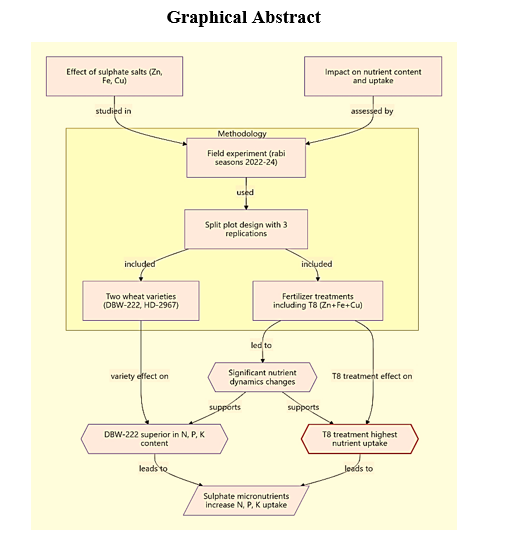
A two-year field experiment was conducted during the 2022–23 and 2023–24 rabi seasons at the Student’s Instructional Farm of Chandra Shekhar Azad University of Agriculture and Technology, Kanpur, Uttar Pradesh, India, to evaluate the influence of metallic micronutrient fertilisation on nutrient concentration and uptake in wheat. The experiment was laid out in a split-plot design with three replications. Two wheat varieties, DBW-222 and HD-2967, were assigned to the main plots, while nutrient management treatments involving soil and foliar application of zinc sulphate, iron sulphate and copper sulphate were assigned to the subplots. The results indicated varietal and nutrient-management effects on nitrogen, phosphorus and potassium concentration and uptake in grain and straw. On a pooled basis, DBW-222 recorded higher nutrient concentration than HD-2967, with 2.33% N, 0.371% P and 0.49% K in grain, and 0.770% N, 0.113% P and 1.189% K in straw. The same variety also recorded greater pooled nutrient uptake in grain, with 143.70 kg N/ha, 22.98 kg P/ha and 30.28 kg K/ha. Among nutrient management practices, soil application of zinc, iron and copper through ZnSO₄·7H₂O at 20 kg/ha, FeSO₄·7H₂O at 12 kg/ha and CuSO₄·5H₂O at 2 kg/ha recorded the highest pooled nutrient uptake. This treatment recorded 147.94 kg N/ha, 28.17 kg P/ha and 35.04 kg K/ha in grain, and 49.85 kg N/ha, 11.28 kg P/ha and 79.13 kg K/ha in straw. The findings suggest that combined soil application of zinc, iron and copper sulphates improved nutrient concentration and uptake in wheat under the studied agro-climatic conditions of the Ganges–Yamuna Doab.
Keywords: Wheat, Triticum aestivum, micronutrients, zinc sulphate, iron sulphate, copper sulphate, nutrient concentration, nutrient uptake, nitrogen, phosphorus, potassium, Ganges–Yamuna Doab